Christo and Jean-Claude Center
1. Gabrovo and culture
Gabrovo Municipality has long embraced the principles and vision of Agenda 21 for culture, fostering consistent and sustainable development through a coordinated range of cultural initiatives. Building on this foundation, the Municipality developed its first Culture Strategy (2014–2024), launched a municipal programme for culture, and applied for the title of European Capital of Culture in 2014. That same year, Gabrovo was designated a Pilot City by the UCLG Culture Committee, and in 2017 joined the UNESCO Creative Cities Network.
Today, Gabrovo is developing a new Culture Strategy for the period 2025–2032, aligned with its renewed candidacy for European Capital of Culture in 2032. The city has established and actively operates a Culture Fund, supporting diverse cultural actors and long-term initiatives. As a member of the UNESCO Creative Cities Network since 2017, Gabrovo continues to strengthen its international cultural profile. These efforts converge in the vision for the Сгristó Center — a future hub for contemporary art, dialogue, and cultural innovation inspired by the legacy of Christo and Jeanne-Claude.
Gabrovo Municipality is developing a brand-new space, field of interest and institution with contemporary art, design and textiles in its focus – the Christo and Jeanne-Claude Center, named after Gabrovo-born Christo.
THE TRANSFORMATION FOR THE OLD TEXTILE SCHOOL OFFERS A UNIQUE PLACE THAT CELEBRATES THE METHOD, THINKING AND PRACTICE OF CHRISTO AND JEANNE-CLAUDE, SUPPORTS URBAN DEVELOPMENT AND LIVEABILITY, AND SERVES AS A LOCAL DRIVER FOR CREATIVE BUSINESSES.
2. Goals and project implementation
2.1. Main aim and specific goals
The transformation for the old textile school in Gabrovo creates a unique place within the city that celebrates the method, thinking and practice of Christo and Jeanne-Claude, supports urban development and liveability, and serves as a local driver for creative businesses. This project develops a vibrant site for presentation of art and knowledge production of international standing that brings together talent in the fields of contemporary art, textiles, urban policies, architecture and design.
The process is based on ongoing dialogue and engagement of a large number of local, national and international stakeholders, prototyping and polishing the planned functions and programmes of the Center, involving local communities and redeveloping both the building and adjacent area and the operations model in a sustainable, energy efficient and ecofriendly manner.
2.2. Development of the project
The project has a 30-year history. A wide community has been working for the establishment of a new art center in Gabrovo, the hometown of artist Christo. The project aims to address local and global social challenges through artistic license, cross-disciplinary sustainable and future-oriented solutions.
Under an agreement signed with Christo and his brothers – Stefan and Anani Yavashev in 2013, the Municipality of Gabrovo received a donation of 50 posters and committed itself to establishing a Center for Contemporary Art Christo and Jeanne-Claude.
Current status of the project: After researching and evaluating various possibilities for using an existing building or constructing a new one, the project team, Gabrovo Municipality and City Council reached the decision to realize the Center in the building of the former Textiles Vocational School. The building is extremely suitable both because of its architectural features and the availability of spacious high-ceilinged laboratories / workshops, which can be transformed into excellent exhibition halls and production spaces, and because of the connection between the main subject of the school – textiles – and the work of Christo and Jeanne-Claude.
As of November 2022, the building’s ownership was transferred from the Ministry of Education to Gabrovo Municipality. In June 2022 the Municipality received a technical assistance grant from the European Commission under the programme Support to New European Bauhaus Local Initiatives, through which consultants of Ramboll Management Consulting have been working with the project team to support the Center’s institutional and business development, a functional analysis, and a brief for an international architectural competition.
Five projects in the public space can be seen in the area of the Christo and Jeanne-Claude Center.
The terrain consists of a main building on 4 floors, spacious yard and small adjacent premises (total: ca. 12 000 sq. m). It was built in the 50s of the 20th century and served as a Textile School, which closed down in 2008. The construction is suitable for its purpose and in very good condition, and in close vicinity to the Museum of Humor and Satire. The surrounding public area is subject to revitalisation through an architectural and urban redevelopment competition in progress. It is situated in the center of Gabrovo along the banks of Yantra River and provides facilities for culture, sports and recreation.
Currently the project team is working with the local art, education and business community, with various national and international institutions to identify needs, stakeholders and partners for this project. So far more than 50 focus groups, discussions and meetings have taken place to ensure a truly participatory process with sustainability in mind both in terms of operations and refurbishment of the building.
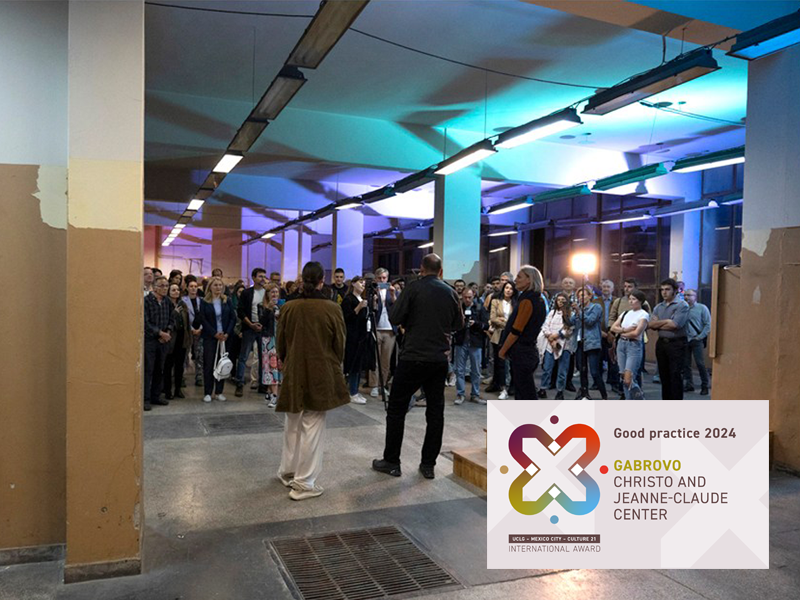
Open doors event at the Christo and Jeanne-Claude Center took place in the period 6-8 October 2023. The CJC Center was visited by over 1,200 people - both local and from across the country. This allowed us to test the main features of the project, introduce it to visitors, gather their ideas and feedback, and their memories of the place (from those who have studied or taught there). The program includes exhibitions, open studios, screenings, lectures, workshops, a pop-up store, and parties, as well as interventions in the urban environment surrounding the Center.
The upcoming activities of the project are organized in two interconnecting directions:
- Institutional development, programming, developing partnerships, strengthening participation and engaging audiences.
- Redevelopment of the physical environment with efficient investment and sustainable approach both in terms of renovation works and maintenance.
They upcoming activities are as follows:
- Setting up a legal body.
- Team recruitment.
- Developing a brief for an international architectural competition.
- Carrying out a two-phase architectural competition, based on the principle of competitive dialogue.
- Organizing events and activities in the Center to present, test and promote its programme.
- Continuous dialogue with potential local and international partners, ongoing study visits and research trips to sites, institutions and cities where similar projects have been carried out.
- Planning, preparing and carrying out the reconstruction process.
THIS PROJECT DEVELOPS A VIBRANT SITE FOR PRESENTATION OF ART AND KNOWLEDGE PRODUCTION OF INTERNATIONAL STANDING THAT BRINGS TOGETHER TALENT IN CONTEMPORARY ART, TEXTILES, URBAN POLICIES, ARCHITECTURE AND DESIGN.
Partnerships and institutional collaborations in this process include governmental, local, business and educational partnerships, as well as with media and research sectors.
There is a preliminary cost-benefit analysis and financial plan for the project and currently the team is looking into possibilities for financial diversification. The main part of the funding will come from public sources, however, both private investment and philanthropy are seen as vital to guarantee a dynamic and efficient approach to management.
3. Impacts
3.1. Direct impacts
The main goal of the project is to nourish talent and counteract the ongoing demographic dropdown, observed in the past 30 years, through developing a place where locals and guests can learn, experience and be inspired by creative processes. The project holds huge potential not just for the city of Gabrovo, but through the cross-sectoral partnerships for the entire region and the country. It is expected to reinvigorate local identity and create a stronger sense of belonging, as well as working, educational and meaningful leisure experiences for the participants in the process and audiences.
Coupled with the forthcoming participation of Gabrovo in the European Capital of Culture 2032 competition and making the most of the city’s participation in diverse networks, dedicated to culture, green development, innovation, the project is an excellent opportunity to test, showcase and further develop its programme and goals against the mirror of local needs and opportunities and international collaboration.
IT IS EXPECTED TO REINVIGORATE LOCAL IDENTITY AND CREATE A STRONGER SENSE OF BELONGING, AS WELL AS WORKING, EDUCATIONAL AND MEANINGFUL LEISURE EXPERIENCES.
3.2. Evaluation
During the process of institutionalization the project can rely on more immediate observations and signs for success, such as level of engagement and motivation of partners and team members, media coverage, public opinion expressed through word of mouth or commentaries in media outlets and social media.
Once formalized, the evaluation can include standard qualitative and quantitative methods and use among others the following instruments:
- Surveys/questionnaires.
- Interviews.
- Observations.
- Focus groups.
- Financial and performance reports.
- Analytics tools for tracking website traffic, user behavior, etc.
- Media coverage.
3.3. Key factors
The key factors identified are:
- Open and transparent process to prevent misunderstandings and ensure alignment with stakeholders.
- Establishing a motivating organizational structure and management system to boost team performance.
- Implementation of a flexible management model to adapt to changes and unforeseen circumstances.
- Ensuring the project remains relevant by staying updated on industry trends and adapting as needed.
- Engaging with a supportive community dedicated to the project's success.
- Engaging with reputable individuals and organizations to maintain project integrity and quality standards.
- Making sure the project remains relevant to local communities and stakeholders at each step of its implementation.
3.4. Continuity
Since the project develops a new site, continuity would simply mean its ongoing development and setting up a successful institution. Replicability, however, could be more relevant to observe, since the management and programmatic model can be reproduced at other places, taking into consideration local needs, opportunities and challenges. Exactly with this goal in mind, the management model for the Center will be developed in close collaboration with the Ministry of Culture, allowing for setting up a blueprint of steps and processes, which can be useful for other locations.
4. Further information
Gabrovo was a candidate for the sixth UCLG – Mexico City – Culture 21 International Award (November 2023 – March 2024). The jury for the award drew up its final report in June 2024, and requested that the Committee on Culture promote this project as one of the good practices to be implemented through Agenda 21 for culture.
Contact: i.hristova (at) gabrovo.bg
Website: www.gabrovo.bg