THRAPSANO TRADITIONAL POTTERY PROJECT
1. Thrapsano and culture
Thirty kilometres southeast of Heraklion is Thrapsano, the most important potting centre in Crete. The village belongs to the Municipality of Minoa Pediada and lies 340m above sea level. It has 1000 inhabitants. Most of them are potters, a hereditary profession passed down from parent to child. There are many opportunities for the development, promotion and upgrading of the area. The Thrapsano Cultural Association, which is supported by the Municipality of Minoa Pediada, has been working to this end for several years through intense cultural activity. The ceramic tradition of Thrapsano will be further highlighted by the completion of the educational centre for contemporary ceramics and pottery, and the support and promotion of local businesses such as the pottery workshops.
THE PURPOSE OF THE CULTURAL POLICY OF THE MUNICIPALITY IS TO EXPLOIT THE CULTURL IDENTITY OF EACH SETTLEMENT IN THE REGION, ENHANCING THE OPPORTUNITIES AND POSSIBILITIES FOR ENTREPRENEURSHIP FOR ALL CITIZENS, ESPECIALLY THE YOUTH.
The cultural policy of the Municipality is based on the natural environment, history, monuments, and local resources. The purpose is to exploit the cultural identity of each settlement in the region, enhancing the opportunities and possibilities for work and entrepreneurship for all citizens, especially the younger generation. Studies have shown that Thrapsano potters are bearers of a ceramic tradition going back to the Bronze Age (3rd and 2nd millennium BCE). A distinctive characteristic was that, until mid-1970s, Thrapsano potters travelled across Crete to areas for suitable ceramic ecology, manufacturing and selling their products on the spot. This itinerant mode of production is unique in Crete and is one of the few examples reported in Greece and worldwide.
Before the project, there was no coordinated policy in this direction by any public or private body.
2. Goals and project implementation
2.1. Main aim and specific goals
This initiative, supported by the Municipality, aims to keep the ceramic tradition alive and encourage its further development by younger generations, to strengthen local communities and economies through crafts, to promote artistic expression and to make academic knowledge accessible to the general public. Hence, the main objective of the project is to familiarise the participants (people of diverse backgrounds, education and interests), especially the youth, with the age-old ceramic tradition of the region and other aspects of Cretan traditional culture, with the aim of understanding, preserving and developing that culture according to the requirements of contemporary societies. We believe that those who know the past can understand the present and look to the future with optimism.
2.2. Development of the project
The Thrapsano Traditional Pottery Project, promoted by the Municipality, aims to preserve and promote the cultural heritage of Thrapsano, to act as a cultural hub of active potters of the region, and to pass down of the potter’s craft to the younger generation. The Municipality supports the activities of the Thrapsano Cultural Association. The Association has succeeded in having the potting tradition of Thrapsano included in the National Inventory of Intangible Cultural Heritage of Greece.
The most important activity of the Association is the cultural festival EARTH WATER FIRE: Celebrating Cretan Pottery from Antiquity to the Present, organised in collaboration with the Hellenic Ministry of Culture, the British School at Athens, and the Centre for the Study of Modern Pottery – G. Psaropoulos Foundation, together with Thrapsano potters. Events include:
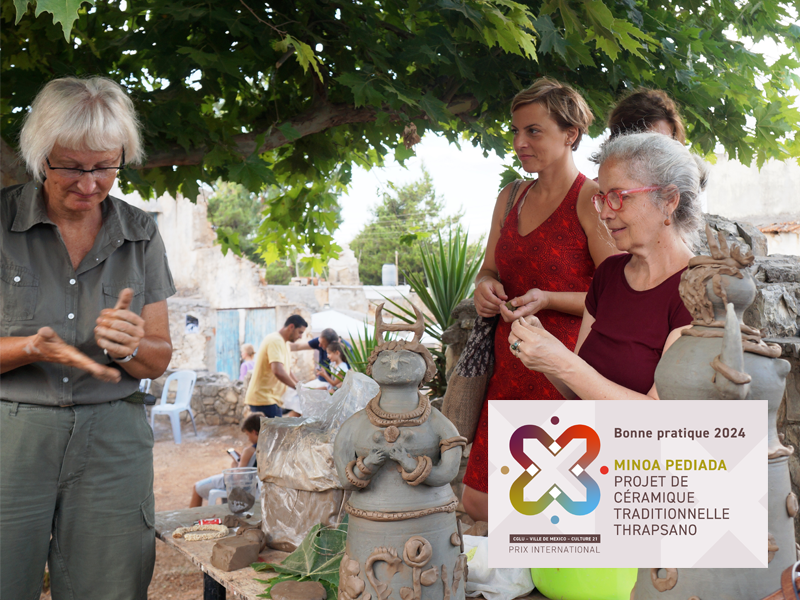
- Lectures by prestigious academics, with particular emphasis on the Thrapsano and Cretan in general ceramic tradition as a living heritage, workshops for adults and children to introduce them to the potter’s art.
- Visits to archaeological sites, art exhibitions, ceramic workshops by Cretan potters, and music evenings with traditional Cretan music.
There was an impressive attendance, including not only inhabitants of Thrapsano but also those from the nearby towns, which demonstrates the importance of preserving the Cretan culture, a precious living heritage with a rich past and a wealth of future prospects.
Another initiative, included in the general policy of the Municipality to promote the Thrapsano traditional pottery, is the establishment of an educational centre in collaboration with the Hellenic Ministry of Culture and the University of Western Macedonia.
The key issues facing the Community of Thrapsano are:
- Continuing support for the festival organised by the Cultural Association;
- Support for the businesses, in terms of work and visitor access;
- Protection and promotion of traditional production units and functions;
- Immediate launch to rebuild the Thrapsano Primary School and construct a new classroom to meet the needs from population growth;
- Flood defence works;
- Road connection to the new Kastelli Airport; and
- Protection, promotion and visitor access to the Bronze Age Palace of Galatas.
THE AIMS IS TO KEEP THE CERAMIC TRADITION ALIVE AND ENCOURAGE ITS FURTHER DEVELOPMENT BY YOUNGER GENERATIONS, WHILE STRENGTHENING LOCAL COMMUNITIES AND ECONOMIES THROUGH CRAFTS, PROMOTING ARTISTIC EXPRESSION AND MAKING ACADEMIC KNOWLEDGE ACCESSIBLE TO THE GENERAL PUBLIC.
Besides the Thrapsano Cultural Association and the Municipality of Minoa Pediada, the project is organised with the support of the Region of Crete (https://www.crete.gov.gr and https://www.enpe.gr/en/perifereia-kritis-en) and the participation of the Hellenic Ministry of Culture, the British School at Athens (http://www.bsa.ac.uk) and the Centre for the Study of Modern Pottery (http://potterymuseum.gr/?lang=en).
The budget of the project is €15,000-20,000. It will have a positive impact on local society, as Thrapsano has become an important cultural centre in recent years, positively affecting the lives of the inhabitants. We also hope to connect Thrapsano to neighbouring sites of cultural interest, particularly the Bronze Age Palace of Galatas (about 5 km south of the village), which the Municipality and the Hellenic Ministry of Culture aims to include on the UNESCO World Heritage List. The prospects are extremely promising and the construction of the new airport of Heraklion at Kastelli will also contribute to this, making the Pediada region a dynamic communication hub.
3. Impacts
3.1. Direct impacts
Since the launching of the project in 2019, the village of Thrapsano has become a dynamic cultural centre. The urban landscape has been upgraded by improving the existing infrastructure (partly damaged in a major earthquake in 2021) and planning new infrastructures. Fresh opportunities for seasonal and permanent employment have been created, as ceramic production and demand has increased, shifting the inhabitants’ mentality to become more outward-looking and raising their level of cultural awareness. The village is also becoming a meeting-place for people with similar interests to those presented by the project, from neighbouring villages, from the rest of Crete and Greece, and even from abroad, creating a multicultural dialogue that opens up new horizons and opportunities. The planned creation of an educational centre for potters will contribute yet further, and we hope to establish Thrapsano as a ceramic centre of international importance that will transform the Cretan ceramic tradition while remaining respectful of the past.
THE MOST IMPORTANT ACTIVITY OF THE ASSOCIATION IS THE CULTURAL FESTIVAL EARTH WATER FIRE, WITH ACADEMIC LECTURES, POTTERY AND CERAMIC WORKSHOPS, VISITS TO ARCHAEOLOGICAL SITES, ART EXHIBITIONS AND TRADITIONAL CRETAN MUSIC.
3.2. Evaluation
The evaluation of the project is based on participation and acceptance by:
- The local community.
- The communities of the wider area.
- Visitors from the neighbouring large urban centres.
- Visitors from abroad.
Data has been gathered on the number of participants and their origin, educational level, professional activity and interests.
3.3. Key factors
The key factor which explains the success of the project is the high level of participation, from the very first year of the project, by people of different backgrounds, educational levels and interests. Of particular interest is the impact of this cultural action on young people, which we consider extremely important. The ever-increasing attendance rate, including members of other neighbouring cultural associations, is highly significant and demonstrates the positive impact of the project.
3.4. Continuity
This project aims to preserve our cultural heritage on the one hand, and to strengthen local communities and economies through handicrafts on the other.
The Municipal Authority will assist in every way in the financial or other support of the Festival and the creation of up-to date, competitive production units, able to cope with the demands of modern times, as the importance of preserving the potter’s craft and promoting the Thrapsano region is highlighted even further.
4. Further information
Thrapsano (Municipality of Minoa Pediada) was a candidate for the sixth UCLG – Mexico City – Culture 21 International Award (November 2023 – March 2024). The jury for the award drew up its final report in June 2024, and requested that the Committee on Culture promote this project as one of the good practices to be implemented through Agenda 21 for culture.
This article was written by Dr Kostis Christakis, Head of the Knossos Research Centre, Municipality of Minoa Pediada, Heraklion, Crete, Greece.
Contact: knossoscurator (at) bsa.ac.uk
Website: https://minoapediadas.gr/