Local Actions
1. Rio de Janeiro and culture
Rio de Janeiro, with approximately 6.5 million inhabitants, is divided into administrative regions. As a large metropolis, it faces significant challenges. The Central and South zones have historically concentrated greater wealth and most cultural services and infrastructure.
In contrast, the North and West zones are poorer peripheral areas, with very limited cultural offerings and infrastructure. In addition, there are numerous favelas, impoverished communities usually located in elevated areas (hills), scattered throughout the city, regardless of region.
The Local Actions programme was created specifically to serve these peripheral regions and favelas, which face higher levels of violence and have socially vulnerable populations. Historically, cultural agents in these areas have found it extremely difficult to access the programmes offered by the Municipal Department of Culture.
Most of these populations lack the institutional support and technical knowledge necessary to meet traditional funding requirements. For its part, the Department of Culture found it difficult to reach cultural entrepreneurs in these territories and overcome barriers to supporting their artistic expressions.
LOCAL ACTIONS WERE CREATED TO SUPPORT CULTURAL PROJECTS IN PERIPHERAL AREAS AND SLUMS OF RIO DE JANEIRO
The programme was created in response to these challenges, designed exclusively to serve this population, which has historically been prevented from fully exercising its cultural rights.
2. Goals and project implementation
2.1. Main aim and specific goals
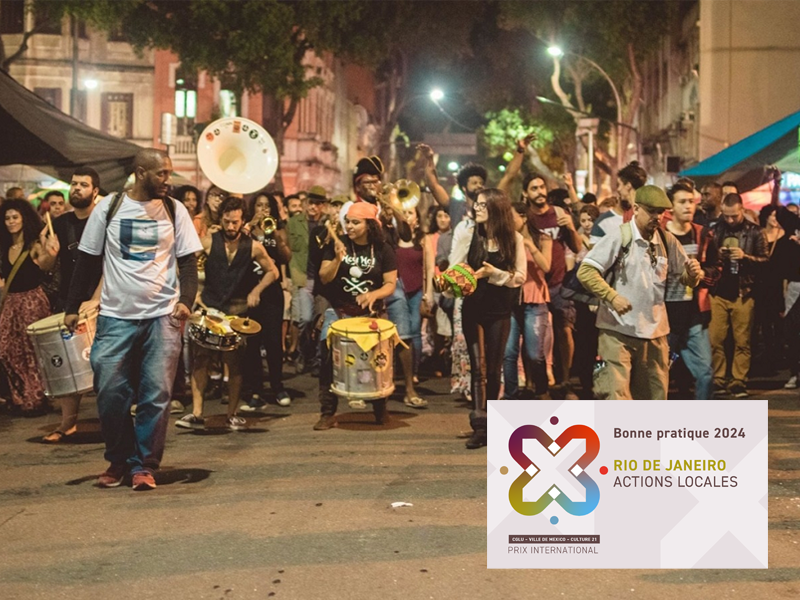
Ações Locais (Local Actions) is a programme created in 2014 to promote artistic projects that have a positive socio-cultural impact on peripheral communities in Rio de Janeiro. The aim is to contribute to the exercise of citizenship, inclusion and positive transformation of territories through culture.
Projects are selected through a public call for proposals, using a prospecting, application and selection methodology specially designed to meet the characteristics of cultural entrepreneurs who have historically had difficulty accessing resources through traditional funding programmes.
2.2. Development of the project
The Local Actions Programme was launched in 2014 and has evolved into an ongoing initiative of the Municipal Secretariat of Culture due to its significant impact, the high level of participation by artists from the periphery, and the results achieved. The programme had new editions in 2015 and 2020.
In 2023, it underwent an expanded edition, with an improved methodology, to be replicated in 2024. Thus, the programme has established itself as a permanent public cultural policy of the city, with the purpose of eliminating barriers that hinder equal participation and access to public resources for cultural agents from the periphery.
Local Actions supports initiatives aimed primarily at people living in poverty; victims of violence; homeless people; people in situations of restriction and deprivation of liberty; people with disabilities; people with mental health issues; the LGBTQIA+ population; women; children, young people and the elderly; traditional communities; the black population; indigenous peoples; and gypsy communities.
The programme is structured in strategic stages, designed to bring agents who have historically been more distant from the institution closer together. It begins with an extensive active search for artists and socio-cultural projects in favelas and suburbs with potential for participation; promotes training activities; conducts the submission of proposals through forms that facilitate the description of the activities; conducts face-to-face interviews between applicants and evaluators; and, finally, monitors the selected projects to ensure the strengthening and sustainability of the activities.
The intention of Local Actions is to democratise and decentralise cultural policy, while also expanding the reach of beneficiaries, including cultural entrepreneurs.
The programme stems from the recognition of the profound inequality in cultural investments in the city, which mainly affects the poorest areas.
In 2023, R$8,330,000.00 (eight million, three hundred and thirty thousand reais) was invested in supporting 163 cultural projects, considering the resources from the Paulo Gustavo Law (Federal Law) and the municipality's own sources.
Of the total number of applicants selected, 41.36% (forty-one point thirty-six per cent) had never received public funding before, reinforcing the democratic nature of the programme.
The following year, R$6,600,000.00 (six million six hundred thousand reais) was invested through the National Living Culture Policy (PNCV), selecting a total of 186 (one hundred and eighty-six) cultural projects, including 154 awards and 32 ongoing projects.
3. Impacts
3.1. Direct impacts
The programme has impacts in several areas.
First, there is an impact on the local community, with an increase in the cultural activities available.
The programme enables the development of new activities and expands the reach of existing ones. The use of public resources injects funding into the lives of participants and generates job opportunities through the hiring of local services.
Second, there is an impact on the professionalisation of participants, many of whom are accessing public resources for the first time. This contributes to the formalisation of their initiatives and the improvement of their technical skills, acting as a gateway to professional careers.
Third, there is an impact on the city's cultural production. By funding new groups, the programme encourages the creation of original content, enriching artistic diversity
THE PROGRAM HAS DIRECT IMPACTS ON THE LOCAL COMMUNITIES, THE CULTURAL SECTOR, AND THE INSTITUTIONAL FRAMEWORK OF PUBLIC POLICIES
Finally, there is an impact on the institutional framework of the Department of Culture. The programme has begun to influence other initiatives, promoting the simplification of processes and additional points for projects involving people in vulnerable situations. What was once a niche programme has become a benchmark for cultural citizenship policies.
3.2. Evaluation
The programme's objectives are evaluated using various indicators:
- Territorial impact indicators: these measure the increase in community participation, the strengthening of local identities and the generation of employment and income.
- Data collection tools: on-site monitoring, conversations with beneficiaries, analysis of reports, photographic and audiovisual records, among others.
- Follow-up: continuous monitoring of supported actions to identify deviations, adjustments, and goal fulfilment.
- Results assessment: comparison between established indicators and achieved results.
- Feedback and continuous improvement: based on the assessment, feedback is provided to proponents to promote the continuity and improvement of initiatives.
3.3. Key factors
Certain aspects are crucial to the programme's success:
- Territorial focus: a territory-centred cultural policy allows for proximity to local demands and realities, promoting decentralisation and democratisation of resources.
- Inclusion of informal cultural agents: including non-formalised agents increases the recognition and participation of those who carry out impactful actions in the territories.
- Debureaucratisation: simplifying financing processes facilitates access for peripheral creators, encouraging the continuity of actions.
- Valuing continuity and territorial identification: reinforces the positive impact and ensures local recognition.
- Effective evaluation and monitoring: ensures follow-up on results and necessary adjustments.
- Action by the Local Coordinator, with strategies such as territorial mapping, mobilisation, listening and follow-up
3.4. Continuity
The Local Actions Programme has been running since 2014, with subsequent editions between 2015–2016 and 2020–2023–2024. Its continuity is maintained because its successful experience has influenced other municipal programmes, which have started to reserve quotas for projects in peripheral territories.
These include: the Cultural Territories Award (2015), FOCA – Rio de Janeiro Culture Promotion Programme (2021–2022) and the Cultural Zones programme (since 2022).
The programme's principles have made territorialised budgeting for peripheral areas and favelas a reality, becoming an essential element of any cultural policy, regardless of the administration.
4. Further information
Rio de Janeiro as a candidate for the sixth UCLG – Mexico City – Culture 21 International Award (November 2023 – March 2024). The jury for the award drew up its final report in June 2024, and requested that the Committee on Culture promote this project as one of the good practices to be implemented through Agenda 21 for culture.
This article was written by, Douglas Resende de Souza, Institutional Relations Coordinator at the Municipal Secretariat of Culture, Rio de Janeiro, RJ, Brazil
Contact: douglasresende.culturario (at) gmail.com and gabinetesmc.culturario (at) gmail.com / inter.riodejaneiro (at) gmail.com
Website: https://prefeitura.rio